


KNOPPIX: a quick and easy welcome to Linux
by Randolph Metcalfe on 1 October 2004
Archived This page has been archived. Its content will not be updated. Further details of our archive policy.
Introduction
KNOPPIX (http://www.knoppix.de/) is a version of the Linux operating system which runs off a CD-ROM without needing to touch the hard disk of your computer. KNOPPIX has a sophisticated set of hardware detection utilities, and usually works everything out for itself. Because everything is run from the CD though, it is not really practical for daily use—but see KNOPPIX REDUX for a clever daily use. It is, however, an excellent way to get a taste for running Linux without having to install any software or upset your existing setup. Plus, since KNOPPIX can access the data on your disks, if you decide to let it, it is often used as an excellent tool for rescuing data from Windows and Linux computers that refuse to boot.
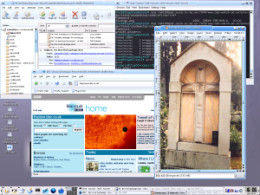 This version, KNOPPIX 3.6, has been remastered by OSS Watch to include requested software especially relevant to UK higher and further education. It has been produced by OSS Watch in conjunction with UKUUG, the UK’s Unix and Open Systems Group, http://www.ukuug.org/.
How to run KNOPPIX
Put it in the CD drive of your PC, and reboot the computer. That’s all! Well, a few caveats:
- Most recent computers will tend to boot from a CD by default, but on older models you may need to tinker with the BIOS setup to tell you computer to boot from the CD.
- KNOPPIX does a good job of hardware detection but it is not foolproof. If it fails, the KNOPPIX web site has some things to try.
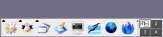
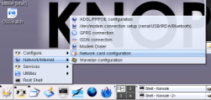
If it can find a DHCP server, the networking is usually set up automatically. Otherwise, select the the squashed penguin menu bottom left:
and use the Network card configuration item:
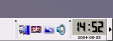
- The OSS Watch KNOPPIX will start up assuming you have a UK keyboard. To switch to a US keyboard, click on the tiny UK flag on the bottom right by the clock.
Why Remaster KNOPPIX?
Each distribution of KNOPPIX is packed with useful and fun software. Indeed, the standard KNOPPIX distribution is so full that there is no room to add anything. In order to include additional software on this CD, some things needed to be removed. Alas, most of the games had to be sacrificed.
There are a number of other customized versions of KNOPPIX available often serving very specialized communities. A catalogue is maintained at http://www.knoppix.net/docs/index.php/KnoppixCustomizations.
Remastering KNOPPIX
Remastering KNOPPIX is not for the faint of heart, but is not that hard. This brief account gives some idea of what is involved: Remastering KNOPPIX knoppixremaster.xml. If you would like to make your own customization of KNOPPIX and would like some advice, do drop us a line.
The Software
This OSS Watch KNOPPIX 3.6 distribution includes:
- Mozilla Firefox for web browsing
- Mozilla Thunderbird for email
- The GIMP for picture editing
- Gnumeric and KOffice for office work NB. OpenOffice has been removed to free up space in this version
- Multimedia players for sound, film, etc.
- The TeX typesetting language
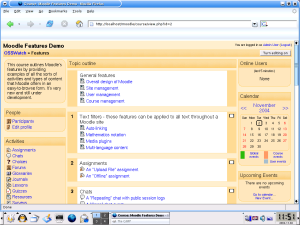
Of special interest to UK higher and further education will be the addition of:
- The Moodle course management system
- RELOAD (Resusable Learning Object Authoring and Delivery) player and editor
- The MySQL database
- Web services with the Apache web server (including PHP5)
- In conjunction with the Text Encoding Initiative Consortium, a variety of tools useful for XML authoring are provided, including extra packages for Emacs, the Roma schema generation service, xsltproc, xmlstarlet, rxp, etc.
If you would like to know precisely what packages are on the CD, there is a full list of software packages removed from the standard KNOPPIX for this distribution http://www.oss-watch.ac.uk/knoppix/Remove; a full list of software packages added to the standard KNOPPIX for this distribution http://www.oss-watch.ac.uk/knoppix/Add; and a list of software packaged locally http://www.oss-watch.ac.uk/knoppix/LocalAdd (see section ).
If you have suggestions for software to include in a future release, please let us know.
OSS Watch KNOPPIX 3.6 ISO
An ISO image is a file containing an ISO-9660 filesystem, essentially a bit-for-bit copy of a CD-ROM. If you download the ISO image you can burn a bootable CD-ROM for yourself, or anyone else, that is an exact copy of any other CD-ROM created from that ISO. There are numerous places on the Internet to learn how to burn a CD-ROM from an ISO. The important thing to be aware of is that you are not merely burning a copy of the ISO to your cd. Rather you are burning a bootable CD-ROM. Popular cd-burning programs such as NERO or K3B will have clear instructions about how to use them to perform this task. Please note: you will need a 700MB blank disc for this.
The OSS Watch KNOPPIX 3.6 ISO image is available here: http://www.oss-watch.ac.uk/downloads/.
KNOPPIX REDUX
One of the annoyances of KNOPPIX is that all your work is lost when you reboot. You can get round this by storing your home directory (which includes things like configuration files for email, browser bookmarks etc) on a disk somewhere. This could be your local hard disk, a floppy disk, or (probably best) a USB memory device. If you store your configuration for email and such on a USB drive, you could happily travel about carrying your entire computing environment on just a KNOPPIX cd and your USB drive.
Using the USB memory device as the example, first plug it into your computer which has been booted with KNOPPIX. KNOPPIX should spot the new device and give it a name like /dev/sda1. Right-click on the icon for this device which has appeared on your desktop. Take the option to mount the drive. Right-click again on the icon and under Actions, change the read/write mode. This is what will permit KNOPPIX to actually write information to a device - remember, KNOPPIX normally never writes to your computer’s hard drive.
Choose Configure from the menu on the little penguin, the second from left on the bottom panel) and select create a persistent KNOPPIX home directory:
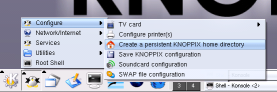
You will then be asked to choose a device
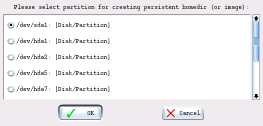
In this example, the USB drive shows as /dev/sda1, and hard disk partititions as /dev/hda1 etc. When you have chosen your device, and moved to the next screen, you’ll be asked whether the whole device should be used, or whether all the work should be done in a file which KNOPPIX will manage; do not choose the first option unless you want that device wiped clean! Finally, you are asked what size of disk to create—the default suggestion is 30 megabytes, which is plenty for most purposes.Your current setup is then copied to the new location, and you should reboot.
When the KNOPPIX CD boots, it comes up with a command prompt. Do not just press return or wait, but type knoppix home=scan and press return. This tells KNOPPIX to look for your home directory on available devices. If your USB device is plugged in, it should be located and used.
Voila! When KNOPPIX comes up, your home directory and settings should be as they were when you last ran the system.
Locally packaged software
To make this CD, we made local Debian packages of a number of packages we thought would be useful. You can find these packages separately at http://tei.oucs.ox.ac.uk/teideb/, but please be aware that this is for experts only, and that this is not an official Debian repository.
Copyright and licensing
To the best of our knowledge, the contents of this CD are all redistributeable, most packages (but not all) are conformant with the Debian Free Software Guidelines. If you have concerns, please do not use or redistribute the software until you have checked the licensing conditions.